
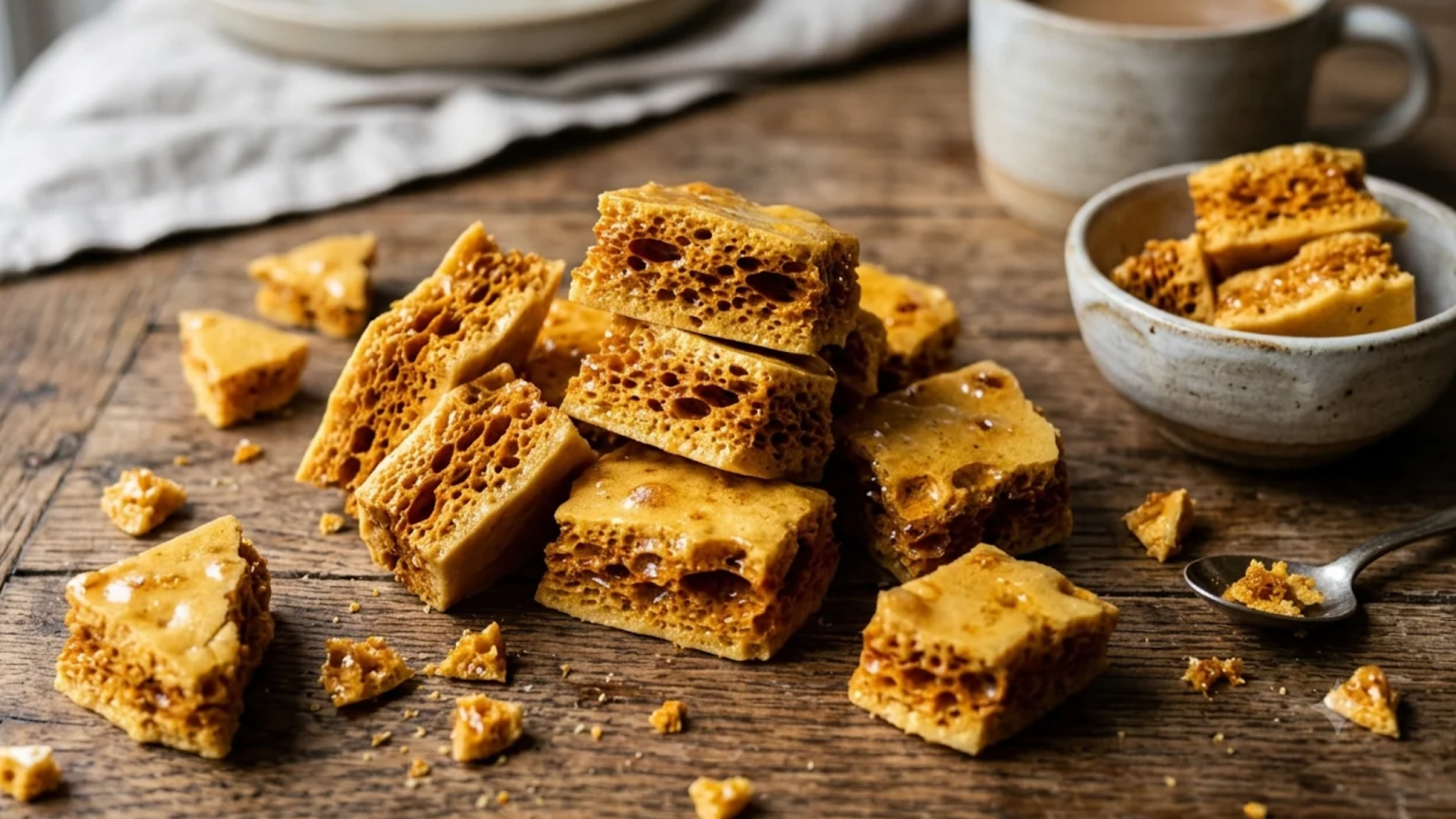
Honeycomb candy is a crisp, airy sweet made by cooking sugar and syrup, then adding baking soda to create hundreds of tiny bubbles. Once cooled, it becomes light, brittle, and easy to break into pieces. It tastes delicious on its own and works especially well with a thin chocolate coating.
If you are wondering how do you make honeycomb candy without ending up with a flat, sticky, or bitter batch, the key is to cook the sugar syrup to the correct temperature and add the baking soda at the right moment. This recipe uses a few basic ingredients and gives you clear steps to follow.
Table of Contents
What Is Honeycomb Candy?
Honeycomb candy is a crunchy confection with an open, sponge-like structure. It is made by mixing baking soda into hot sugar syrup. The baking soda creates carbon dioxide bubbles, which expand through the mixture. As the sugar cools, it hardens around those bubbles and forms a crisp, honeycomb-like texture.
Depending on where you live, you may also hear it called sponge candy, sponge toffee, cinder toffee, or hokey pokey. The names and recipes can vary slightly, but the basic method is similar.
Ingredients for Homemade Honeycomb Candy
You only need four main ingredients to make a basic batch. Measure everything before you start because the final steps happen quickly.
| Ingredient | Quantity | Purpose |
| Granulated sugar | 220 g | Creates the hard candy base |
| Golden syrup | 90 g | Helps prevent sugar crystallisation and adds flavour |
| Water | 60 ml | Helps dissolve the sugar |
| Baking soda | 2 teaspoons | Creates the airy honeycomb texture |
Optional ingredients:
- 150 g milk or dark chocolate for coating
- A small pinch of sea salt for extra flavour
Golden syrup gives the candy a traditional caramel flavour. Light corn syrup can be used as a substitute. Avoid replacing it with honey unless you are following a recipe developed specifically for honey, as it can change the flavour and cooking behaviour.
Equipment You Need
Prepare your equipment before heating the sugar syrup:
- Heavy-based saucepan with high sides
- Digital candy thermometer
- Wooden spoon or heat-resistant spatula
- Whisk
- Baking parchment
- Small, deep baking tin, approximately 20 cm square
- Heat-resistant gloves or oven mitts
A candy thermometer is particularly useful because the syrup needs to reach the hard-crack stage. A regular kitchen thermometer that does not measure high temperatures may not be suitable.
How Do You Make Honeycomb Candy?
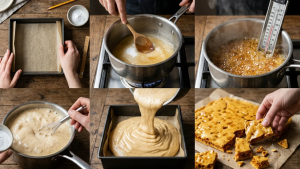
Follow these steps carefully. Once the caramel reaches the required temperature, you will need to work quickly.
Step 1: Prepare the Baking Tin
Line a 20 cm square baking tin with baking parchment. Make sure the parchment covers the base and sides so the candy does not stick.
Place the tin close to your cooking area. Measure the baking soda and keep it ready in a small bowl. You will not have time to measure ingredients after removing the syrup from the heat.
Step 2: Combine the Sugar, Golden Syrup, and Water
Add the granulated sugar, golden syrup, and water to a heavy-based saucepan.
Place the pan over medium heat. Stir gently until the sugar dissolves and the mixture looks uniform. If sugar crystals remain on the sides of the pan, carefully brush them down with a pastry brush dipped in water.
Once the syrup starts boiling, stop stirring. Stirring at this stage can encourage sugar crystals to form and affect the finished candy.
Step 3: Cook the Syrup to 300°F (149°C)
Attach a candy thermometer to the saucepan, making sure its tip does not touch the bottom of the pan.
Let the syrup boil until it reaches 300°F (149°C), the hard-crack stage. This usually takes several minutes, but the time depends on your pan and stove.
The syrup should turn a light golden amber colour. Use the temperature reading as your main guide rather than relying on colour alone. Remove the saucepan from the heat as soon as it reaches the target temperature.
Step 4: Add the Baking Soda
Immediately add the measured baking soda to the hot syrup.
Whisk quickly for a few seconds until the baking soda is incorporated. The mixture will foam, expand, and become much lighter in colour. This reaction creates the air pockets that give honeycomb candy its familiar texture.
Do not continue whisking for too long. Overmixing can cause the mixture to lose some of its air before it sets.
Important: Hot sugar syrup can cause serious burns. Do not touch or taste the mixture, and keep children away from the cooking area.
Step 5: Pour the Mixture into the Tin
Immediately pour the foaming mixture into the prepared tin.
Let it spread naturally. Do not press it down, stir it, or tap the tin against the counter. These actions can release the air bubbles and make the candy denser.
Leave the tin undisturbed at room temperature for approximately 30–60 minutes, or until the honeycomb is completely cool and hard.
Step 6: Break the Honeycomb into Pieces
Once the candy has cooled, lift it out of the tin using the parchment paper.
Break it into bite-sized pieces with your hands or a sharp knife. The finished honeycomb should be brittle and snap cleanly rather than bend.
Your homemade honeycomb candy is now ready to serve. You can enjoy it plain or coat the pieces with melted chocolate.
How to Know When Honeycomb Candy Is Ready
The appearance and texture tell you whether the recipe has worked.
- Light and airy inside: The broken pieces should show plenty of small and medium-sized air pockets.
- Hard and brittle: Properly set honeycomb snaps when broken.
- Dry surface: It should not feel wet, tacky, or sticky.
- Golden colour: The candy should have a pleasant caramel colour, not a dark brown or burnt appearance.
If the candy bends or feels chewy after cooling, the syrup may not have reached the correct temperature. A reliable candy thermometer helps prevent this problem.
Common Honeycomb Candy Problems and How to Fix Them
Even a simple sugar recipe can be sensitive to temperature, timing, and moisture. Here are the most common problems and their likely causes.
| Problem | Possible cause | How to prevent it |
| Candy turns flat | Old baking soda, delayed pouring, or excessive mixing | Use fresh baking soda and pour immediately |
| Honeycomb becomes chewy | Syrup did not reach the hard-crack stage | Cook to 300°F (149°C) |
| Candy tastes bitter | Sugar was overcooked or too much baking soda was added | Measure accurately and remove the syrup at the correct temperature |
| Surface becomes sticky | Humidity or moisture exposure | Cool completely and store in an airtight container |
| Sugar turns grainy | Syrup was stirred after boiling or crystals formed on the pan sides | Stop stirring once the syrup boils |
Humidity is particularly troublesome when making honeycomb candy. Sugar absorbs moisture from the air, which can soften the finished pieces. For the best result, make the recipe on a dry day and store the candy as soon as it has cooled.
How to Make Chocolate-Covered Honeycomb
Chocolate-covered honeycomb is a popular way to serve this candy. The chocolate adds a smooth coating that contrasts with the crisp centre.
- Break the cooled honeycomb into small, manageable pieces.
- Melt milk or dark chocolate in a heatproof bowl over a pan of gently simmering water. Make sure the bowl does not touch the water.
- Stir until the chocolate is smooth.
- Dip each honeycomb piece into the melted chocolate, coating it completely or covering just one side.
- Place the coated pieces on a parchment-lined tray.
- Leave them at room temperature until the chocolate sets, or refrigerate briefly if necessary.
Avoid leaving chocolate-coated honeycomb in a humid environment. Moisture can soften the candy even when the chocolate coating looks firm.
How to Store Honeycomb Candy
Store honeycomb candy in an airtight container at room temperature. Keep it in a cool, dry cupboard away from sunlight, heat, and moisture.
Do not refrigerate plain honeycomb. Condensation can form when the candy is removed from the fridge, making its surface sticky and its texture less crisp.
For the best crunch, enjoy the candy within several days of making it. If you have coated it with chocolate, allow the coating to set completely before placing the pieces in the container. Separate layers with parchment paper to prevent them from sticking together.
Wrapping Up
Making this sweet at home requires only a few ingredients, but temperature and timing matter. Cook the sugar syrup to 300°F (149°C), add the baking soda quickly, and pour the mixture into the prepared tin without disturbing the bubbles.
Now that you know how do you make honeycomb candy, you can prepare a crisp batch at home and enjoy it plain or covered in chocolate. Keep it away from moisture after cooling, and you will have a light, crunchy treat ready to share.
Frequently Asked Questions (FAQs)
Q1. How do you Make Honeycomb Candy Without a Candy Thermometer?
It is harder to judge the exact cooking stage without a candy thermometer. But you can test a small drop of syrup in cold water. At the hard-crack stage, it should form brittle threads that snap when removed. A candy thermometer is more reliable and makes the process easier to control.
Q2. Why Do You Add Baking Soda to Honeycomb Candy?
Baking soda produces carbon dioxide when added to the hot syrup. The gas forms bubbles throughout the mixture, creating the airy structure. Without baking soda, the candy would set into a much denser piece of hard caramel.
Q3. Can You Use Corn Syrup Instead of Golden Syrup?
Yes. Light corn syrup is a suitable substitute for golden syrup in this recipe. Both help reduce sugar crystallisation, although the final flavour may differ slightly.
Q4. Why Is My Homemade Honeycomb Candy Sticky?
Honeycomb usually becomes sticky when it absorbs moisture from the air. It can also turn soft if the sugar syrup was not cooked to the hard-crack stage. Make sure the candy is completely cool before storing it in an airtight container.
Q5. How Long Does Homemade Honeycomb Candy Last?
For the best texture, eat homemade honeycomb within several days. Store it in an airtight container in a cool, dry place. Warm conditions and humidity can make it sticky sooner.
 vinay