
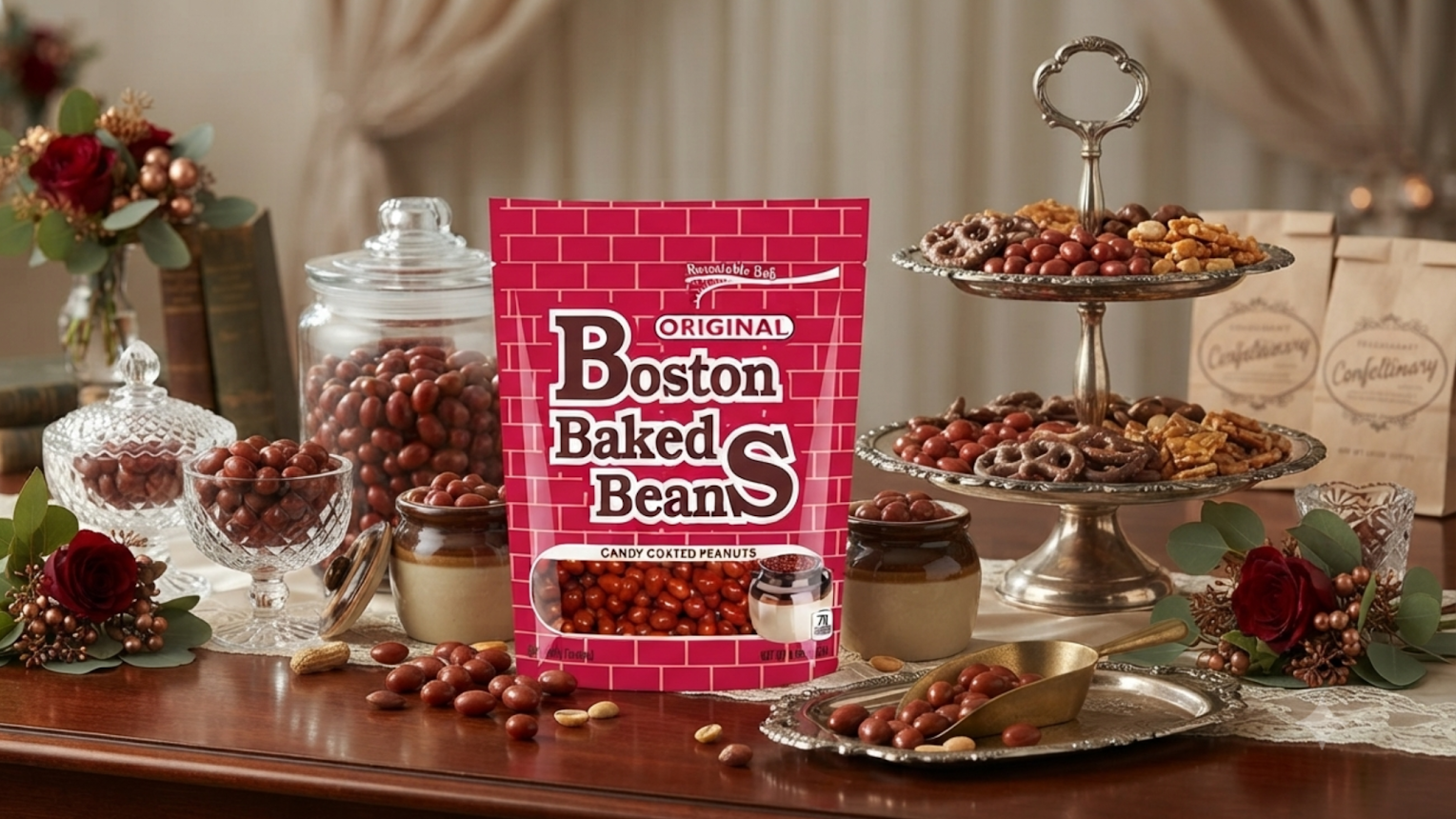
Boston baked beans candy is a peanut based confection made by the Ferrara Candy Company. It has no actual beans in it. It consists of a roasted peanut center coated in layers of hardened sugar syrup, dyed reddish-brown to resemble molasses baked beans. The candy was popularized in the 1930s after being developed in Chicago in 1924.
Pop open a small red box at the movie theater, and you know the sound before you taste anything: that dry rattle of tiny red shells bouncing around cardboard. Boston baked beans candy has been making that exact sound since the 1920s. Here’s the detail that surprises most first-time buyers: there isn’t a single bean inside. It’s peanuts, wrapped in a hard sugar shell, wearing a name that belongs to a completely different dish.
This guide covers the verified history, the full ingredient list, how it compares to similar candies, and direct answers to the questions people search for most.
Table of Contents
What Is Boston Baked Beans Candy?
Boston baked beans candy is a panned confection made of a roasted peanut center coated in multiple layers of hardened sugar syrup, finished with a reddish-brown dye and a glossy glaze. It does not chew like a jellybean. It cracks. That snap is the defining texture trait of the product.
| Detail | Information |
| Brand | Boston Baked Beans |
| Manufacturer | Ferrara Candy Company |
| Year introduced | 1924, popularized through the 1930s |
| Main ingredient | Roasted peanuts |
| Coating method | Cold-panning |
| Signature color | Reddish-brown |
| Contains actual beans | No |
The color is intentional, not random. Manufacturers use a reddish-brown dye blend because it echoes the look of beans simmered in molasses, the tone associated with a traditional New England bean pot.
The History of Boston Baked Beans Candy
The candy traces back to European candied-nut traditions from the 1800s, was first marketed under the “Boston Baked Beans” name by Necco around 1875, and was later developed into its modern, widely recognized form by Salvatore Ferrara in Chicago in 1924.
Timeline of key events:
| Year | Event |
| 1800s | Candied peanuts and almonds sold by European street vendors; closest ancestor is the French burnt peanut |
| 1875 | Necco (New England Confectionery Company) sells candy-coated peanuts under the “Boston Baked Beans” name |
| 1924 | Salvatore Ferrara develops his version in Chicago through Ferrara Pan Candy Company |
| 1930s | Ferrara’s version becomes commercially popular and outpaces earlier competitors |
| Present | Ferrara Candy Company continues production under the same name and recipe style |
Some sources claim the candy is 400 years old. That figure actually refers to the original New England bean dish, not the candy. The candy itself is just over 100 years old.
Why Is It Called “Boston” If It Was Made in Chicago?
The name is a marketing choice, not a geographic fact. Necco, which first used the name around 1875, was based in Massachusetts. But the version that became dominant was made by Ferrara in Chicago. The “Boston” label stuck because it evoked New England’s baked bean tradition, giving the candy an instant sense of nostalgia and Americana. There is no production facility in Boston connected to this candy. The name functions purely as a flavor and heritage cue.
How Boston Baked Beans Candy Is Made
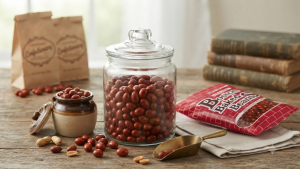
The candy is produced using a technique called cold-panning, where roasted peanuts are layered with sugar syrup inside a rotating drum until a hard shell forms.
Step-by-step breakdown:
- Roasting the peanuts – Spanish peanuts are used for their small size and high oil content, which retains flavor through the coating process.
- Building the shell – Peanuts go into a large revolving pan. Sugar syrup is added slowly in stages, drying between layers.
- Adding color – Red 40, Yellow 5, Yellow 6, and Blue 2 are blended to create the reddish-brown shade.
- Final glaze – Confectioner’s glaze (shellac) and carnauba wax are applied last, giving the shell its shine and crunch.
The entire process takes hours, which is why this candy’s texture is difficult to replicate with faster manufacturing methods.
Full Ingredient List and Function
Standard ingredients: Sugar, peanuts, corn syrup, modified corn starch, acacia (gum arabic), confectioner’s glaze (shellac), artificial flavor, carnauba wax, white mineral oil, Red 40, Yellow 5, Yellow 6, Blue 2.
What each ingredient does:
| Ingredient | Function |
| Sugar, corn syrup, corn starch | Base structure of the candy shell |
| Peanuts | Core ingredient and primary flavor |
| Acacia (gum arabic) | Binds color and glaze layers to the shell |
| Confectioner’s glaze (shellac) | Creates the glossy outer coating |
| Carnauba wax | Adds moisture resistance |
| Red 40, Yellow 5, Yellow 6, Blue 2 | Create the signature reddish-brown color |
Dietary Compatibility of Boston Baked Beans Candy
Not every candy fits every diet, and this one comes with a few restrictions worth knowing before you buy a box for someone with specific dietary needs. The shellac glaze used for shine is the main sticking point, since it comes from an animal-derived source rather than a plant-based one. Below is a breakdown of how this candy holds up against common dietary categories.
| Diet/Restriction | Compatible? | Reason |
| Vegan | No | Confectioner’s glaze (shellac) is insect-derived |
| Vegetarian | Depends on personal preference | Shellac comes from lac insects, so some vegetarians avoid it while others do not |
| Gluten-Free | Yes | No wheat-based ingredients are listed |
| Kosher | Select products | Kosher status depends on the specific product and certification |
| Nut-Free | No | Peanuts are the main ingredient |
| Dairy-Free | Yes | No dairy ingredients are typically listed, but check the package for allergen and cross-contact information |
Nutrition Facts
A small handful of this candy goes a long way in terms of sugar and calories, given how little food volume is actually in each piece. Here’s what a standard serving looks like on paper, along with how it stacks up against a couple of other well-known candies people often compare it to.
Per standard serving (13 pieces):
| Nutrient | Amount |
| Calories | 70 kcal |
| Fat | 2.5g |
| Sodium | 0mg |
| Sugar | 10g |
Compared to a peanut M&M, calorie counts are similar, though the thinner shell on this candy may contain slightly less added sugar per piece. Compared to Red Hots, which have no nut center, this candy provides more protein due to the peanut base.
Allergen Information
- Primary allergen: Peanuts. This candy is unsafe for anyone with a peanut allergy, since the peanut is the structural core of every piece, not an optional ingredient.
- Cross-contact warning: Manufactured in facilities that also process milk, eggs, almonds, coconut, and soy.
- Alternative for peanut-allergic snackers: Sunflower-seed-based panned candies made with a similar cold-panning method are available from other brands.
Boston Baked Beans Candy vs. the Real Dish
The dish originates from Puritan Sabbath cooking traditions, where beans were baked overnight so families could eat without cooking on Sunday. The candy has no historical connection to this practice beyond a shared name.
| Category | Candy | Dish |
| Origin | Chicago, 1924 | Colonial New England, 1600s |
| Main ingredient | Peanuts | Navy beans |
| Sweetener | Refined sugar | Molasses |
| Method | Cold-panning | Slow-baking in a pot |
| Purpose | Snack | Full meal or side dish |
Fun Facts and Common Myths
- Movie-theater staple: Popular at concession stands due to its small size, low price, and shelf stability.
- Not the same as peanut M&Ms: M&Ms include a chocolate layer between the peanut and shell; this candy does not.
- Not discontinued: Still actively manufactured and sold by Ferrara Candy Company nationwide.
- Regional stocking gaps cause confusion: Some stores stop carrying it locally, which fuels false discontinuation claims.
- The “400-year-old candy” myth: That age applies to the dish, not the candy.
- Color variants exist: Some seasonal packaging includes mixed colors, though the recipe stays the same.
- Name is marketing, not geography: “Boston” was chosen for its association with New England baked beans, not an actual manufacturing location.
Where to Buy and How to Store It
- Common package sizes: 1-ounce theater box, 4.3-ounce grocery box, and bulk bags (up to 5 lbs).
- Buying tip: Compare price per ounce rather than price per box, since bulk bags typically offer better value.
- Storage tip: Store in a cool, dry, airtight container. Humidity is the main cause of the shell losing its crunch over time.
Wrapping Up
Boston baked beans candy is a peanut-based confection named after a dish it has no ingredient connection to. It was developed in Chicago, popularized in the 1930s, and continues to be produced using the same cold-panning method used a century ago. It contains no beans, is not vegan due to its shellac glaze, and remains in active production despite periodic online rumors of discontinuation. The name endures because it was built for recognition and nostalgia, not geographic accuracy.
Frequently Asked Questions (FAQs)
Q1. Will Boston baked beans candy give you gas like real beans?
No. Since it contains no actual beans, just peanuts and a sugar shell, there’s no bean-related digestive effect. Any gas concern only applies to real baked beans, not the candy version.
Q2. Can you bake with Boston baked beans candy?
Yes. It holds up well in cookies, brownies, and cake decorations, adding crunch and a pop of color. Since the shell is heat-stable at moderate baking temperatures, it doesn’t melt the way chocolate candy would.
Q3. Where can you buy Boston baked beans candy near you?
It’s commonly sold at candy stores, drugstores, and convenience stores, along with major online retailers and the Ferrara Candy Shop website. Bulk bags are widely available online for parties or baking.
Q4. Does Boston baked beans candy taste like actual baked beans?
No. It tastes like a sweet, roasted peanut with a crunchy sugar shell. The only similarity to real baked beans is the reddish-brown color, not the flavor.
Q5. Are there different flavors or varieties of Boston baked beans candy?
The classic version is peanut-based with a sweet, nutty flavor, but some retailers offer variations, including different color mixes for seasonal packaging. Flavor variants beyond the original are limited and not widely distributed by the main manufacturer.